Classifier Evaluation

Real world tasks are often unbalanced. The best baseline for comparison is nonuniform. A classifier should be evaluated on skill gain instead of raw accuracy.
Class imbalance
Looking at the distribution of classes in a benchmark dataset will reveal imbalance. We can show this using datasets lmsys/toxic-chat SetFit/sst5and ehovy/race.

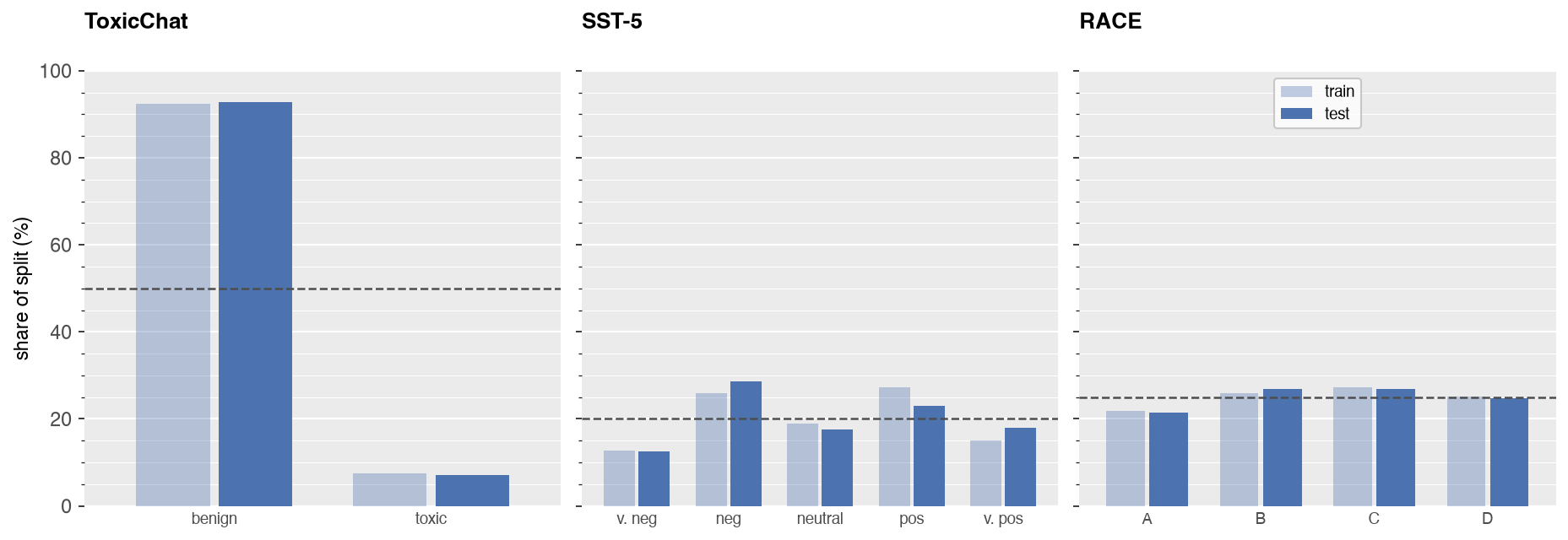
ToxicChat is an example of extreme imbalance. More than 90% of the examples are “benign” where the task is to identify “toxic” text.
The other problems also exhibit moderate, but noticeable imbalance.
SST-5 is scoring problem to predict the rating a person has assigned to a movie based on their review text. Relatively few examples are labeled as “very negative” and a plurality are “negative.”
RACE is a multiple-choice question dataset. Slightly fewer examples have “A” as the correct answer choice.
The dashed line shows the uniform expectation of the classes of each dataset at 50%, 20%, and 25% respectively.
Accuracy and skill
A model‘s accuracy is a measure of the fraction of correct predictions it makes.
We show this by evaluating models tasksource/ModernBERT-base-nli and convaiinnovations/laya on all 3 datasets, as well as a bag-of-words naïf Bayes model evaluated on ToxicChat and SST-5.

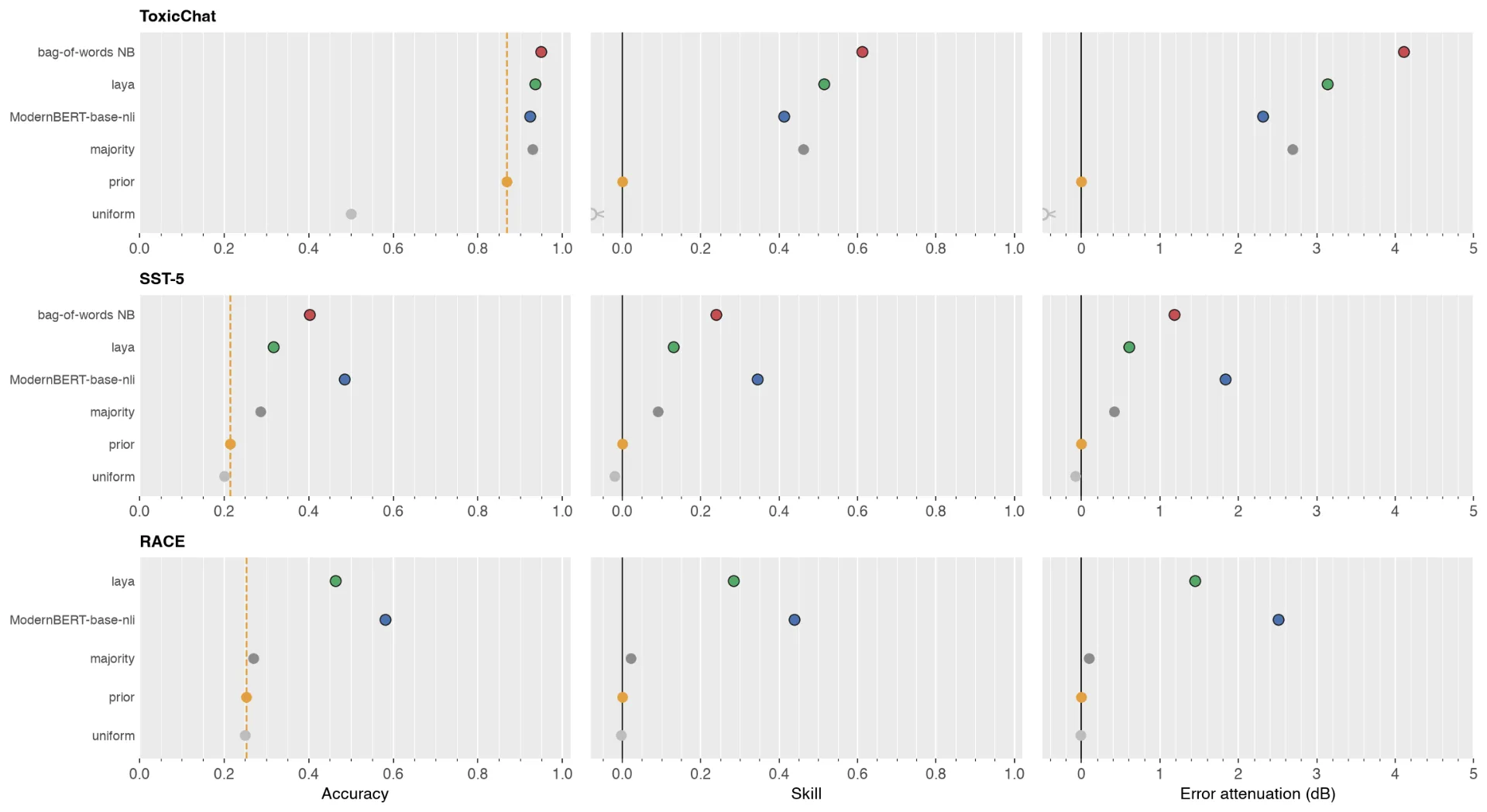
A prediction drawn from the prior class distribution is more accurate than a uniform prediction for an imbalanced task.
A model’s skill or error attenuation is measured from the task prior, not a uniform baseline.
skill = (accuracy − baseline) / (1 − baseline)This shows the fraction of predictive headroom the model has gained over a prior baseline. Skill gain can also be represented as measure of error attenuation in decibel units.
Operating characteristics
A model’s response is tunable by its operating point threshold, which adjusts the relationship between its true positive and false positive characteristic rates.

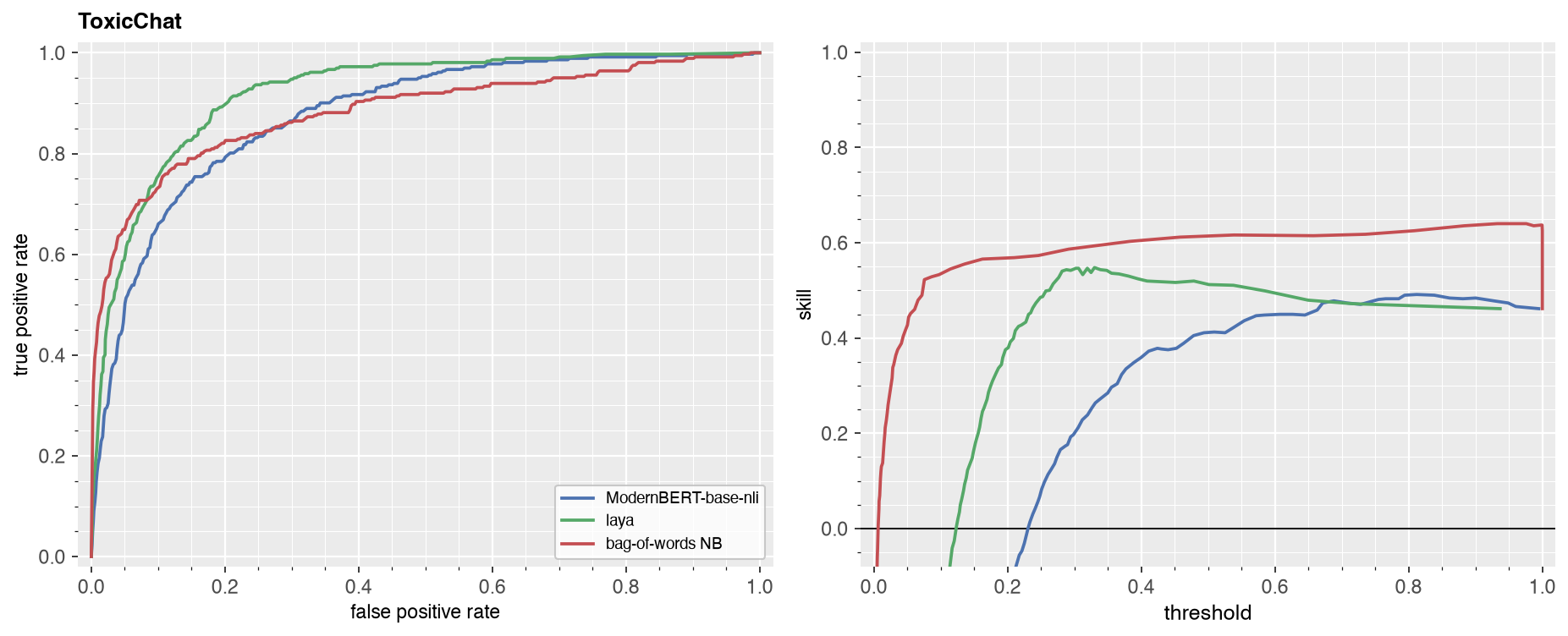
A 50% false positive rate is rarely an acceptable operating point for deploying a model. An economic decision must be made to operate the model at an acceptable level of fallout. Consequently, the attainable true positive rate and skill are affected by the chosen operating point.
Abstention
A model’s response is also adjustable with abstention coverage to prevent it answering when it has low confidence.

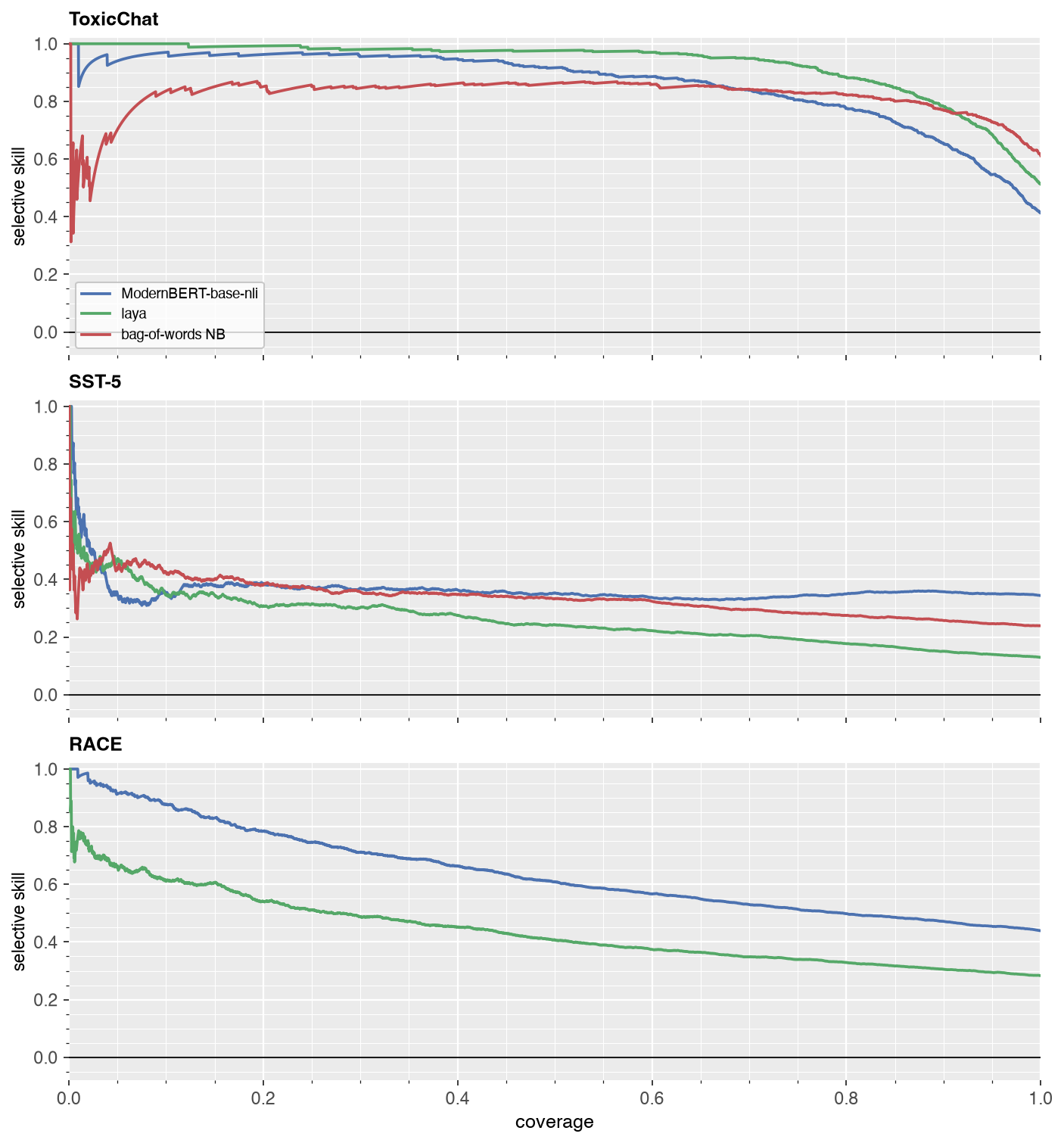
Abstention changes the population a model acts on. The model demonstrates selective skill in its answers within that population.
Another economic decision must be made to assign an escalation path for abstention.
Conclusion
Real world classification tasks are unbalanced. Measure skill gain over a prior baseline instead of raw accuracy. Economic decisions determine your operating point and performance.