What's the AT Protocol
Answers to why I need a "Bluesky" account.

Who Owns Your Voice? Why I'm Building VoxPort on the AT Protocol
I've always loved listening to podcasts. It was a way for me to almost escape and listen to other people talk, instead of just thinking to myself. A while back, almost a year exactly I think, I was in Seattle for a conference called CascadiaJS. I was listening to a lightning talk about something called the AT Protocol. I had no clue how to actually pronounce it, @protocol or A-T-Protocol, but once the talk was over, it clicked for me.
The thought of how existing platforms control what you can and cannot do is crazy to me. I've never been much of a social media person or even a technical person. Still blows my mind that I've been blogging. 😬😆But, if you've ever built an audience on Instagram, YouTube, or a podcast, there's a bit of uneasiness underneath this. The followers, the content, everything you've built doesn't really belong to you. If you wanted to take all of your followers from Instagram or your content to a different platform, how would you, or would you even be able to? It all is stored on someone else's computer, under someone else's rules. They can change algorithms, raise prices, or shut the doors, and you're basically screwed.
That's why I've been building VoxPort, a podcasting platform, on something designed to fix exactly that. It's called the AT Protocol (or "ATProto"). I'm going to try and explain it to you without a lot of the bs. (maybe some bs/tech lingo..) Let me explain it because I think it matters for anyone who makes things online, not just devs and engineers.
Protocol, not platform
Here's the single most important idea: ATProto is a protocol, not a platform.
The best comparison is email. Email isn't a company, it's a set of shared rules. Because everyone agreed on those rules, you can email a friend on Gmail from your Outlook account without a second thought. Nobody has to ask Google's permission.

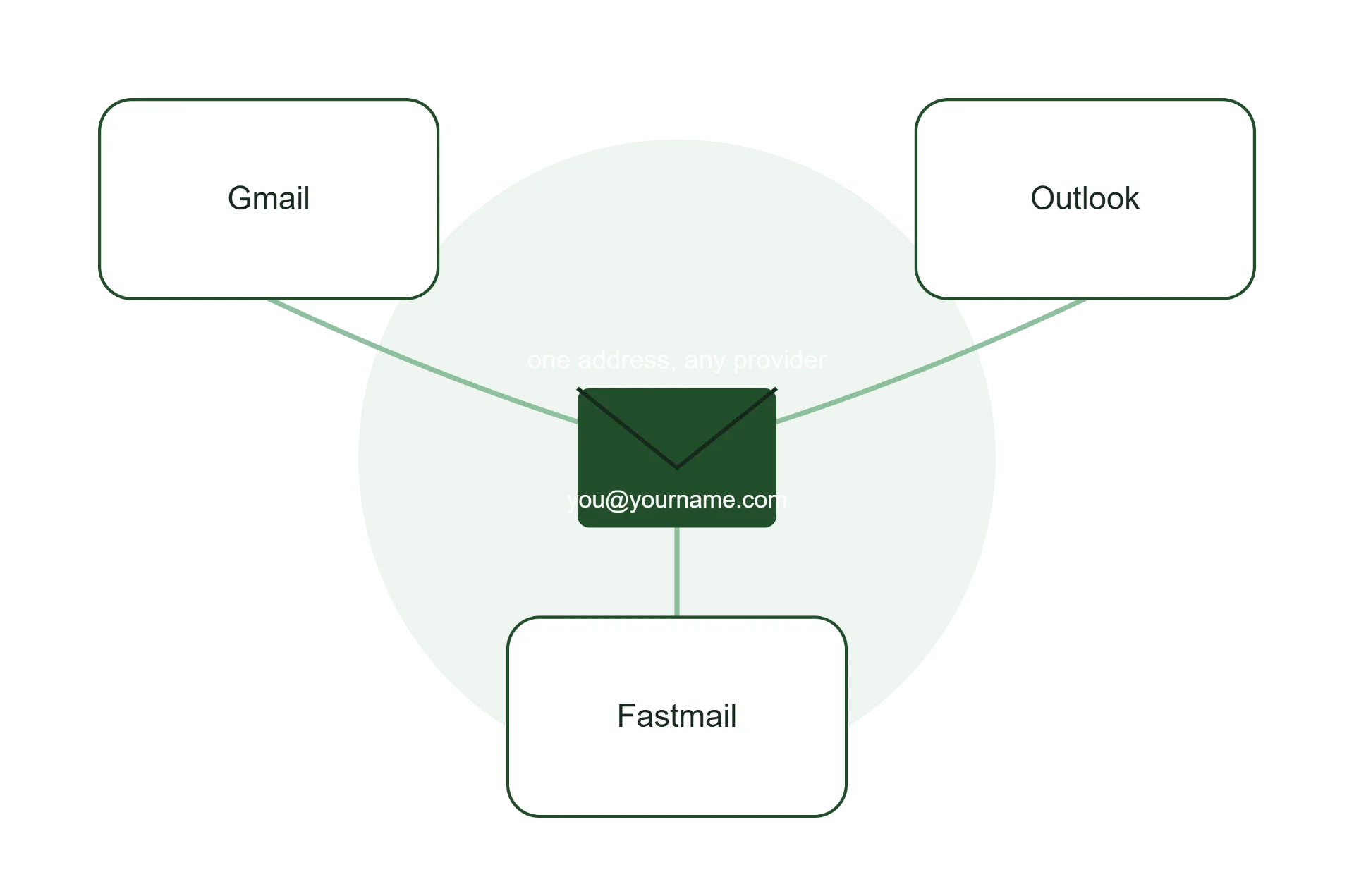
Now compare that to Instagram. Instagram is a platform, a single company that owns the rules, the data, and the front door. You can't take your Instagram followers to TikTok. There's no "switching providers." You're locked in.
ATProto brings the email model to social apps and media. Bluesky (the Twitter-like app you may have heard of) is just one app built on it. VoxPort is another. And because we speak the same protocol, they can talk to each other. That's the whole premise.

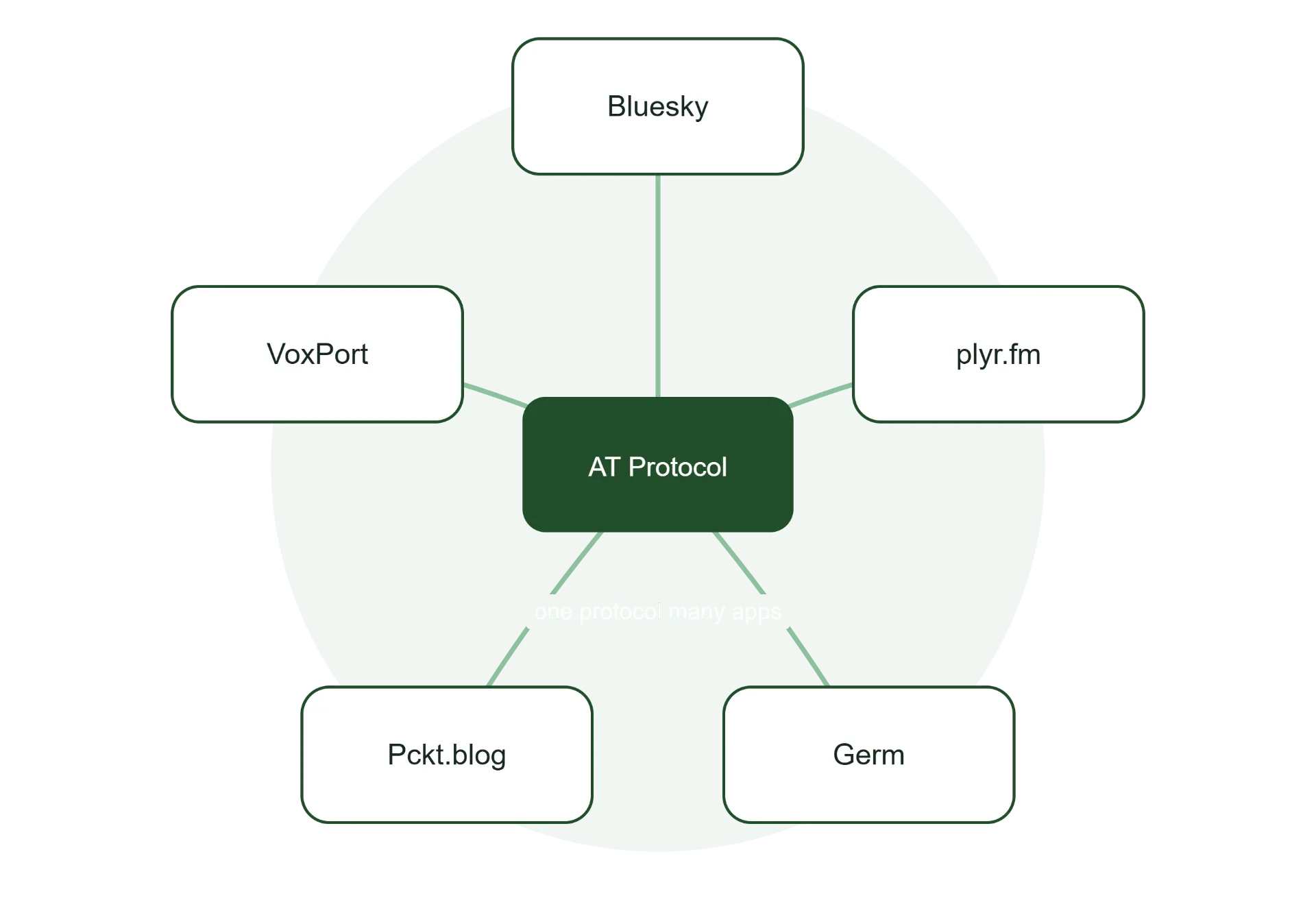
So does VoxPort actually require a Bluesky account? Right now, yes, but let me explain a bit more on why this is.
When you sign in, VoxPort uses ATProto's own OAuth, not some VoxPort specific login. You type in a handle, VoxPort looks up where that identity lives, and sends you to that identity's home server to approve the sign-in. Today, for almost everyone, that home server is Bluesky's and the reason is simple: Bluesky is the easiest place to get an ATProto identity right now. You sign up, you get a handle, you're in. The alternative is finding another PDS provider or running your own server, which is possible on the protocol. It's just more work, and most people (understandably) don't want to do that just to publish a podcast.
But I want to be honest, this is not something that the protocol forces on VoxPort, it's just what I have currently set up. ATProto is open, so nothing prevents someone from running their own server or VoxPort from adding sign-in through other providers (PDSs) in the future. I plan to eventually set up VoxPort's own PDS later on. The protocol doesn't care where your identity lives, it only cares that everyone can read it the same way.
So today, the practical answer is, you sign in with Bluesky. Down the road, that won't be the only way.
To make that possible, ATProto has a few key pieces. Here they are, one example at a time.
1. Your identity is permanent and portable
On ATProto, you have two names.
The first is a DID. Think of it as your ID number, like a phone number that follows you for life. It's ugly and you'll never type it, but it's yours for as long as you control it.
The second is your handle. It's a friendly name, like jared.com or jared.bsky.social. This works a lot like a phone number you're allowed to keep when you switch carriers. The handle simply points to your permanent DID. If you want to change your handle later, you can. Mine is jaredlemler.com, because I own that domain and can point it at my identity instead of borrowing one created by Bluesky. Everyone who follows you still follows you, because underneath, your real identity never changed.
2. Your data lives in a home you can move
Every ATProto user has a Personal Data Server, or PDS. This is where your data is stored: your posts, your likes, your follows.
Picture it as your house. Right now most of us live in a company's apartment building (Instagram's servers, YouTube's servers). We don't own the unit, and we can be evicted. A PDS is a house you can actually own or rent from a landlord you chose and can leave.
And here's the part that has no equivalent in today's apps: if you don't like your current PDS, you can pick up your entire house and move it somewhere else, and everyone still knows how to find you. Your identity, your followers, your history; all of it comes with you. Nobody has ever been able to do that on a social network before.
Inside your house, your data is stored in something called a repository, basically a tidy, tamper-proof filing cabinet. Every item in it is cryptographically signed, which is a fancy way of saying each one carries your unforgeable signature. Anyone can verify a post really came from you and wasn't secretly altered, like the way a notary stamp proves a document is genuine.
3. A shared language everyone agrees on
For different apps to understand each other's data, they need a shared vocabulary. In ATProto these are called Lexicons, and they're just agreed-upon blueprints for what a piece of data looks like.
My favorite way to think about this is to compare it to baseball. Every position on the field has a number, a shortstop is 6, second base is 4, and 1st base is 3. Every scorekeeper from little league to the majors, uses those same numbers to record a play. Say the shortstop fields a ground ball, throws to the second baseman covering the bag for the out at second, and he throws it to first for the out there. That's a 6-4-3 double play. Start it at second base instead and it's a 4-6-3. Doesn't matter which fielders actually turn it, the notation always follows the same numbering. Anyone who knows how to read a scorebook can pick up a stranger's scorebook from a game they've never seen and know exactly what happened, without the two scorekeepers ever having to talk to each other. Nobody invented their own private shorthand for scorekeeping, the whole sport agreed on one a long time ago. Lexicons have that same idea, but for data. A "podcast episode" lexicon says an episode has a title, an audio file, a duration, a publish date. Once that blueprint is public, any app can read a VoxPort episode and know exactly what it's looking at without any extra work or deals being made.
4. A public square anyone can build on
When you post something, your PDS announces it to a giant public stream of everything happening across the whole network. It's named the firehose, imagine a public radio broadcast that never stops, carrying every new post, like, and follow from everyone.
Anybody can tune in. Services called App Views listen to that firehose and organize it into something useful, kind of like how Google crawls the web and turns it into a clean, searchable index. Bluesky's app is one App View. VoxPort is building another view of that data for podcasts.
If someone builds a better podcast-discovery app tomorrow, it can read all the same shows without asking anyone's permission.
What this actually means for VoxPort
- Your show is yours. When you publish a podcast on VoxPort, the episode's record, its title, description, and where to find the audio, is written to your own PDS as an open, standardized record. VoxPort holds a copy to make things fast and pretty, but we are not the sole owner of your life's work. That's a deliberate choice.
- You're not trapped. Because it's built on a protocol, VoxPort can't become a bug infested motel you can't check out of. If I ever do a bad job, your identity and your records go with you. Honestly, that constraint keeps me honest, I have to earn your stay, every month.
- It still works with normal podcast apps. ATProto is the future-facing layer, but I also generate a standard RSS feed for every show, the same technology Apple Podcasts, Spotify, and Overcast already use. So your listeners don't need to know or care about any of this. It just works, and it's future-proof. More details on this in my other blog.
AT Protocol & RSS v2 - Jared Tries to Blog
A Superset, Not a Replacement
jared-tries-to-blog.pckt.blog - Your show is discoverable in the wider network. Because VoxPort speaks the shared language, a listener's activity. a follow, a like, a mention over on Bluesky, can be connected back to your episodes. Your podcast isn't stuck on an island; it's part of a living network.
Why I care enough to build it
I can't imagine how it would feel to spend years building an audience, and then something changes, or the algorithm shifts, or the whole platform shuts down, and you're left with nothing. Not because you did anything wrong. It's because you never actually owned or controlled any of it in the first place.
Nobody should be trapped like that. That's the problem a protocol actually fixes, not the tech part, the who's in charge part. VoxPort is my shot at building something cool that genuinely (in my opinion) is good for podcasters, on a foundation that isn't trying to own them to do it.
There's more I'd like to cover but let's just see how this goes 😄