My 2026 AI experiments: Hermes, OpenCode, and a home server

My AI workflows, home setup, and what I learned building them.
When I'm at a job, the daily goal is shipping features in the codebase - there's no time to question the tools, you just use what works, and it is most likely Claude Code. Between jobs, that pressure lifts, and I finally get to slow down and actually explore the workflows and tooling itself. That's where extra lessons about AI engineering and agentic flows come from.
So I spent the last 3 months quietly experimenting with my daily AI stack. The result runs on a local Mac Mini, uses Hermes and OpenCode, costs around €30/month across two subscriptions, and covers all my jobless needs. I just want to share my setup and I'm curious where you would push it further.
I left Claude Code for OpenCode
After losing my job, my first motivation was to reduce AI spending. I used to pay €90/month for Claude Code Max, the only plan with the usage limits my workload required.
I switched to OpenCode to save money, but also to explore alternatives. I was already not happy with Claude Code. It was slow and reaching limits faster than before. With OpenCode I had a chance to test open-source models and form opinions about them. For daily-driver use, the open-source models are faster and way cheaper than the closed US lab models, and just as capable. BTW: OpenCode also offers a few free models that are good enough to start, but be aware that most likely they are free because they use your data for training.
For example a full day of running Hermes with DeepSeek V4 Flash costs under a dollar. You can access it via the pay-per-token OpenCode Zen product or get OpenCode's Go subscription ($10/month) for occasional use (but limits run out quickly). My main programming model today, MiniMax M3, costs €20/month for a generous token plan. I would need to upgrade for a full-time coding job but for now it's enough. I have not tested Fable 5 yet, so no fair comparison to Anthropic's flagship.
Another benefit is model independence. I can swap models per task, per agent, per harness, or fall back to free models when I run out of paid limits. I do a lot of open-source work anyway so I don't mind using my prompts for AI training. I also do not need to worry about token optimisations the way many friends using Claude Code still have to. It surprises me how many companies just burn money on flagship models without ever questioning whether a cheaper model would do the job.
The Mac Mini as a home cloud
I wanted to experiment with Hermes (similar to OpenClaw, but safer to run out of the box). I needed a dedicated machine for that. I decided on the M4 Mac Mini and actually got FOMO as they were quickly selling out. I managed to get the version with 24 GB of RAM, which is not enough for local LLMs that were also on my experiment list. I gave up on local inference after one day, with the conclusion that I'd need at least 64 GB of RAM to make it workable. On the other hand, cloud access to DeepSeek V4 Flash could be an easier and cheaper alternative than running local LLMs anyway. The machine earns its keep without a single local model as well: it is the always-on home for my agents, and everything in my current setup builds on that.
I'm using Mac Mini as my home cloud server for agent hosting and a Telegram gateway for agent communication, plus a bunch of self-hosted services: a Google Photos replacement, a music server that resuscitated a 20-year-old MP3 collection, Time Machine backups, and more.
The unexpected unlock was treating the home server as my actual development machine. I did not plan it, but I naturally started writing code where my agents live and collaborating with them there. I SSH in from my laptop to work on the projects my agents use, and to review their changes.
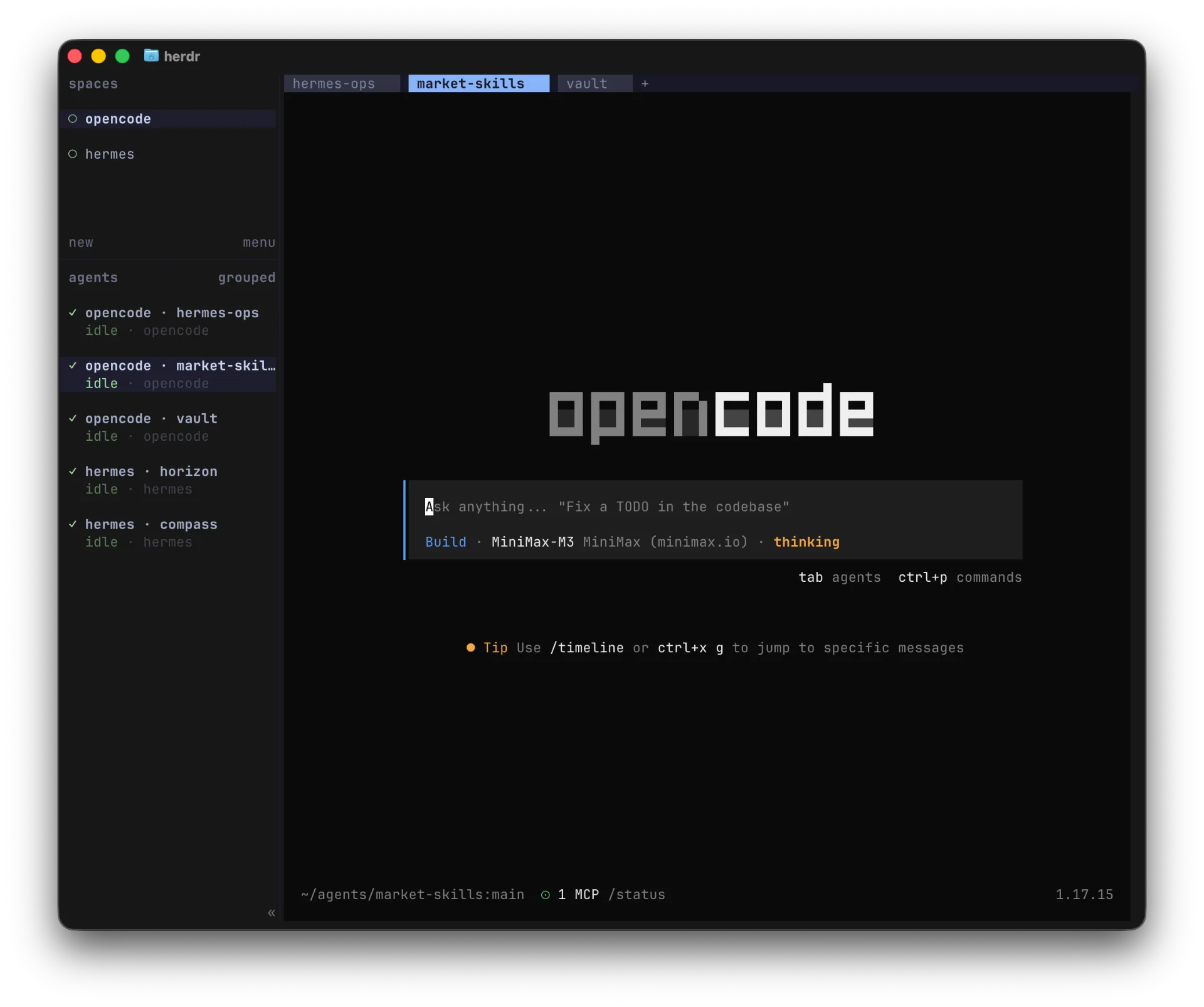
Recently I started using herdr — an app similar to tmux but built specifically for managing multiple running agents. Feels like a game changer. I detach from a long-running agent job, shut the laptop, walk away, and resume later by reattaching.

Three Hermes profiles, three specialised responsibilities
Hermes is the orchestrator. Each profile is its own agent with its own skills and tools repo, its own MCP servers, and its own conversation history. The specialisation matters for agent quality.
Market analyst is the agent I spend the most time on. Its goal is to act as a trading and investment assistant, interpreting data and providing recommendations. It monitors the portfolio, configures and monitors automated execution pipelines, and runs risk analysis. I have an open-source market-skills repo that we are building and improving together. The outcomes are still questionable though, I wouldn't trust it to run autonomously, but it can aggregate and analyze amounts of data I would never be able to process myself.
Career advisor is the second profile. It helps with job search and broader opportunity discovery. It manages an open-source career-ops project I forked and adjusted for my needs. I stopped browsing job boards. Instead I'm getting Telegram messages when new roles are posted that fit my profile. The agent evaluates them, surfaces gaps and strengths, generates a tailored CV PDF, and helps me prepare for interviews. I still fill the application forms myself. Separately, it monitors Reddit, X and Hacker News for broader opportunities, which helped me apply for a few open-source grants and reach out to people and projects.
Coding worker is the third profile, a delegated executor the other two call into via the built-in Kanban board. The intended workflow, for example: market analyst identifies a bug in a chart indicator, writes a spec, and opens a Kanban ticket. The coding worker takes the ticket, fires OpenCode, delivers the bugfix, and reports back to the market agent, who verifies and updates its own internals to use the fixed feature. Unfortunately, the code quality produced this way is not up to my standards.
The pattern that works better for me: When any of the agents finds a bug or an improvement worth making, it writes a spec file in the destination folder (where the relevant codebase lives) rather than touching the code itself. The spec is a plain markdown brief: what's broken, the expected behaviour, constraints, and a few pointers to the relevant files. I SSH to the server, run an OpenCode session myself with that spec as the starting point, and solve the problem. The code quality is way better that way. It is a clean division of labour — Hermes is good at noticing and describing, OpenCode is good at implementing, and I stay the one accountable for what ships.
Guardrails I introduced from the beginning
Local git history everywhere an agent edits. Hermes edits itself, which is a great but potentially dangerous thing. I wanted to see what that actually meant, so I set up local git repos in every folder an agent touches, including its own home. Local-only git repo, no remote. The point is rollback and incremental visibility into changes. That also helps me understand how the system works.
A second agent watching the first one's diff. I have a saved prompt in OpenCode called hermes-ops that, on demand, reviews recent changes inside the Hermes profiles directory for red flags, then auto-commits if everything looks sane. OpenCode is reviewing Hermes's self-modifications. I set it up from the beginning to have extra eyes on what Hermes is doing. I often use multiple agents to review each other's output and give feedback.
VS Code Remote SSH for visual diffs. I keep VS Code open with the Remote extension connected to the home server for each repo I'm working with. This way I can visually inspect agent activities, including code changes from OpenCode but also self improvements from Hermes.
What is still not working
My goal would be to set up Hermes with cron jobs to continuously improve itself. It has been rough so far. Skills do evolve when I push back on them, but the wins are small and the regressions are real. The "delegate coding via Kanban" approach is another failure so far.
I would also like Hermes to be smarter. OpenCode produces better output on hard coding tasks, despite both using the same model. Hermes wins on orchestration, cron, self-editing skills, and connectivity. Talking to the agents from Telegram is super convenient on the go. The ideal tool would be somewhere in the middle. A coding-aware orchestrator, or an orchestrator-aware coding tool. I'm not aware of anything like that being available today. Maybe it is time to start writing my own harness. I have been looking into pi.dev as well.
Closing
Don't get me wrong, I am not telling you to ditch Claude Code. I am just showing you that there are alternatives. Being locked to a single model vendor is a risk any organisation must be aware of. You have to build systems that are model agnostic, that can be easily swapped for alternatives. I advise looking into local inference as a backup plan. The models get better and hardware gets more optimised. I believe a small office server running open-source models for a team could cost around $4000 USD, and it is worth having when US providers change their minds again. Lucky for me I have time to explore all of that while enjoying summer.
What do you think I should add or change in my setup? What does your AI workflow look like?