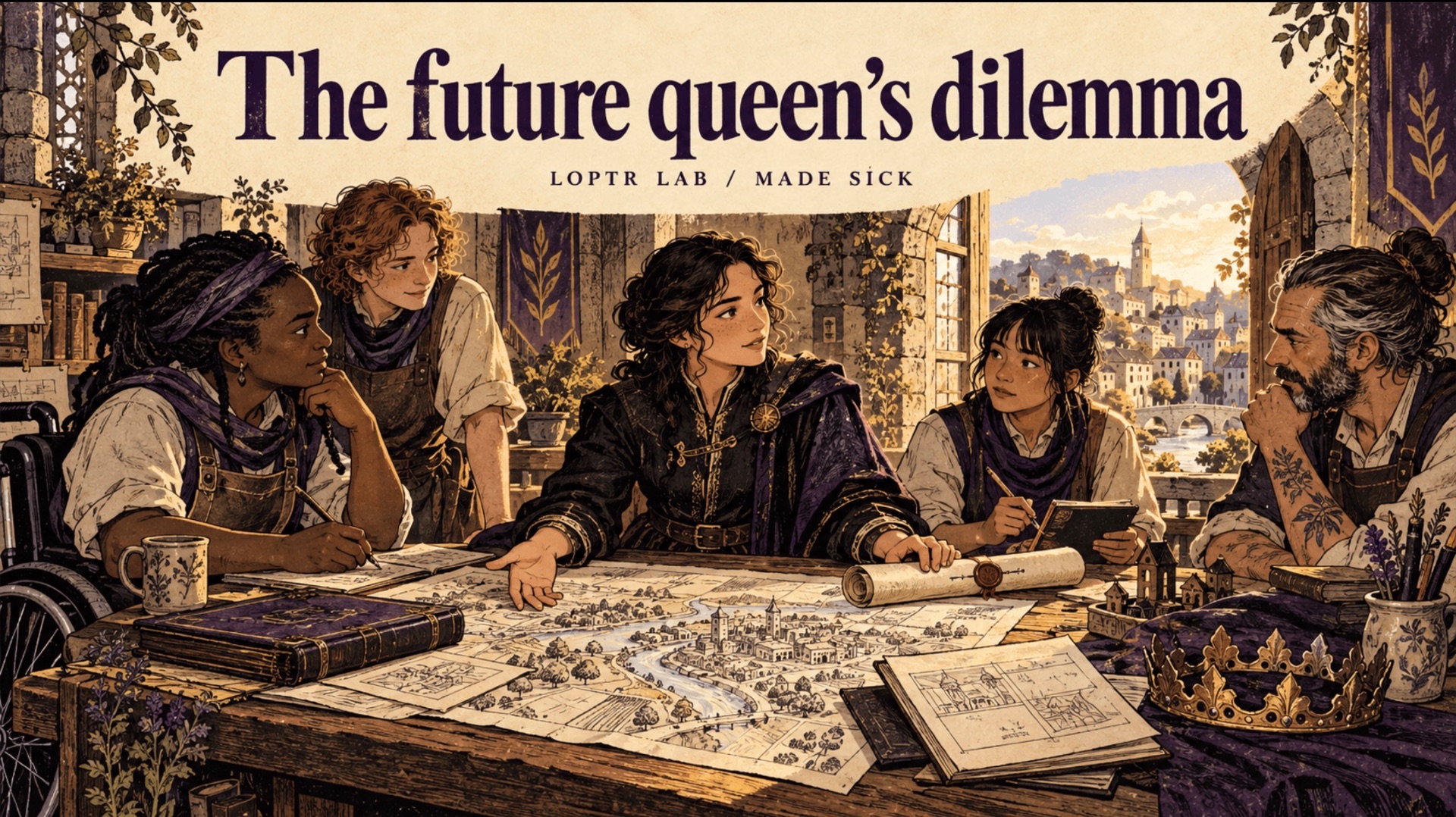
The future queen's dilemma

She was promised to a king before she was asked.
That's how the old stories open. A kingdom needs stability, a match is arranged, and the marriage is what makes her secure. Her own talent, her own work and whatever she might build on her own count for less than the signature on the alliance. The arrangement isn't cruel, exactly. It's the system working the way it was designed to.
In the version I'm writing, the future queen doesn't want the throne. She wants to give the kingdom to the people who keep it running. Before she can do that, she has to work out what the alliance was actually for, what it protects, and what it costs her.
That's my dilemma too. Here it is without the costume.

The arrangement
I'm disabled, and I'm building a business in public: Loptr Lab, 50 Ways to Leave Another, and PIXIE, the system that waits for your permission before it touches anything you own.
Every self-employed person I know has heard the same advice: get a job with benefits, or marry someone who has one. For disabled founders, the rules decide whether that second option helps or hurts.
Here are the public rules for 2026, from the Social Security Administration:
- SSI pays at most $994 a month and has a $2,000 asset limit. If two SSI recipients marry, they get $1,491 a month together, which is 1.5 times one person's benefit instead of twice. If the spouse doesn't receive SSI, part of their income is counted as the recipient's.
- SSDI doesn't change with marriage. Earning more than $1,690 a month can end eligibility, and for self-employed people SSA can count unpaid work hours as work.
- Housing assistance usually counts a spouse's income toward household income.
These rules treat a disabled person's financial stability as something a household provides. A spouse's paycheck counts. My own work counts for less, and for some people it can count against them. Under these rules, a partner becomes a line item on a benefits form. Two disabled people who marry get $497 a month less than if they had stayed single. Nobody should have to plan a wedding around a spreadsheet, and right now disabled people do.
People have asked whether I should just get married. Whether marriage would help, hurt or change nothing depends on rules I'm still confirming in writing. I won't make any decision that depends on those rules, marriage included, until I have the answers.
Why I've built the way I have
The future queen's first move is to refuse to pretend the arrangement isn't there. Mine has been to build right up against the rules, in public, so you can see where they are.
- I've drawn $0 from Loptr Lab. Money I take out can count against support I rely on, and I won't guess how it will be counted.
- I don't offer contributors cash. I won't promise pay I can't safely carry, and I won't hint at money that doesn't exist. Contributors get a written scope, credit and the right to stop at any point.
- I document everything. Agencies count the same dollar in different ways, and a public record is the protection I have.
- PIXIE waits for permission. That design decision came from the same experience. When a system can act on your behalf without asking, you stop owning your own life.
Giving away the kingdom
She doesn't want to be the queen who owns everything. She wants a kingdom that belongs to the people who build it, with her own share capped, written down and visible to everyone.
These are the principles I'm committing to now:
- The founder's pay follows written rules. No payment reaches me through a side door. The historical "$1 salary" always had one: the dollar-a-year men kept collecting from their companies, and the CEOs had stock. I'm not taking a symbolic dollar. I'm publishing the rules.
- There is one lifetime cap on everything I'm ever paid from this work, retirement included. I'll publish the number once I know which rules it has to fit within.
- The community's work stays theirs. Contributors keep ownership and grant a license. Revenue sharing exists only when someone signs an agreement for it.
- If the crown can't hold, the kingdom passes on. If Loptr Lab is sold or shut down, the IP goes to a mission-aligned organization or is released under an open license, and contributors' work goes back to them.
- Every year there's a public report. It shows revenue by stream, what I was paid against the cap, and where the rest went.
The numbers come after the written answers. A written answer could make a specific promise unsafe to keep, and I'd rather tell you now that I'm waiting than break a promise later.
What happens next
What I know: the public rules above. I've drawn $0. Contributors get written terms and the right to stop, and they don't get cash.
What I don't know yet: how the rules that apply to me will treat my specific situation. I've asked the agencies involved for answers in writing.
What happens next: on the first of every month, I'll post the same short update, even when it says "still waiting":
- Written answer #1: requested / received / not yet
- Written answer #2: requested / received / not yet
- Founder draw this month: $0
- Contributor terms: unchanged, or a link to what changed
- What I learned about the rules: public rules only, with the source linked
When both answers arrive, I'll publish the founder pay rules and tell you which rule changed my plan. My personal benefit details stay private.
If you're in the same position
If you're disabled and thinking about starting something, Social Security runs a free program called WIPA (Work Incentives Planning and Assistance). A WIPA counselor will analyze how work affects your benefits. You can find yours at choosework.ssa.gov/findhelp. Ask for the analysis in writing.
How the story ends
I don't know yet. In the story, the future queen's answer isn't to refuse the king or accept him. She makes the arrangement visible to everyone and builds something that doesn't depend on it. If it works, the record shows one way a person can build without having to be married into security. If it doesn't, the record still shows exactly where the walls were, so the next person can start further in.