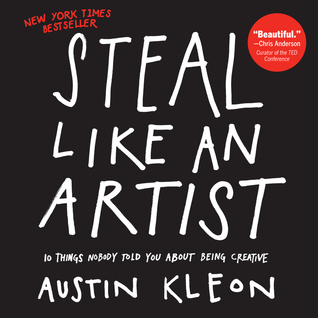
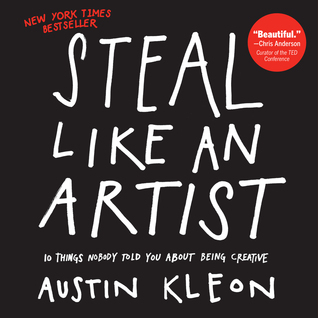
Steal Like an Artist by Austin Kleon (2012)


The General Summary
At its core, Steal Like an Artist is a manifesto for the modern creator. Kleon’s main premise is liberating: nothing is completely original. Instead of the crushing pressure to create something from a "blank slate," Kleon argues that all creative work is a remix of what came before.
The book is structured around ten simple lessons that demystify the "tortured genius" trope. It teaches you how to collect influences, build a "creative lineage," and—most importantly—how to "fake it until you make it" by emulating your heroes until you find your own voice.
The 10 Principles of "Steal Like an Artist"
1. Steal Like an Artist
No work is truly original; it’s all a remix. Kleon explains that an artist is a collector—not a hoarder. You must choose what to "steal" (influences, ideas, styles) and curate them into your own unique "genealogy of ideas." If you steal from one person, it’s plagiarism; if you steal from many, it’s research.
2. Don’t Wait Until You Know Who You Are to Get Started
You don’t find your voice and then start working; you find your voice by working. He encourages "faking it until you make it." By imitating your heroes, you eventually fail to be exactly like them—and those "failures" are actually where your own unique style is born.
3. Write the Book You Want to Read
The best advice isn't "write what you know," it's "write what you like." If all your favorite creators collaborated on a project, what would it look like? Go build that. Fill the gap in the market that you personally wish didn't exist.
4. Use Your Hands
In the digital age, we get stuck behind screens. Kleon argues that "the computer is a perfectionist’s tool." To get truly creative, you need to get messy. Use markers, paper, and physical objects to engage your body. This is where the Analog vs. Digital workspace concept comes in.
5. Side Projects and Hobbies Are Important
Don’t throw away your "distractions." Often, the work you do while you’re "procrastinating" on your main project is actually your best work. Having multiple hobbies keeps your brain fresh and prevents burnout.
6. The Secret: Do Good Work and Share It with People
In the beginning, nobody cares what you’re doing—and that’s a gift! Use your "obscurity" to experiment without pressure. Once you’ve made something cool, put it on the internet. Share a "scrap" of your process every day to build an audience slowly.
7. Geography Is No Longer Our Master
You don't have to move to a creative hub like Paris or New York to be an artist. You can build your own "world" through your library, your internet connections, and your workspace. However, he does suggest leaving home occasionally to keep your brain from getting too comfortable.
8. Be Nice (The World Is a Small Town)
Stop fighting and start making friends. Don't waste energy on "creative trolls." Instead, write "fan letters" (publicly or privately) to people whose work you admire. Validating others' work is a great way to enter the global conversation.
9. Be Boring (It’s the Only Way to Get Work Done)
The "wild artist" trope is a myth that leads to burnout. Kleon advocates for a stable life: keep your day job, stick to a routine, and keep a logbook of what you did each day. Taking care of yourself physically and financially gives you the mental space to be creative.
10. Creativity Is Subtraction
In an age of information overload, the "limitless" is paralyzing. You don't need more time or more tools; you need constraints. Figure out what to leave out of your work. By choosing what not to do, you define your style and get things finished.
Key Takeaways for Your Creative Journey
- Don't wait until you know who you are to get started. You find your identity through the act of making things, not through thinking about them.
- Garbage In, Garbage Out. You are a mashup of what you choose to let into your life. Curate your "inputs" (books, movies, friends) like an artist to ensure your "outputs" are high-quality.
- Climb the Family Tree. Don't just follow one person; study everyone they were influenced by. This creates a deep well of inspiration that belongs only to you.
- The Secret to Success is Consistency. Kleon emphasizes the "boring" parts of life: keeping a day job for financial freedom, sticking to a routine, and "not breaking the chain" on your calendar.
- Geography is no longer our master. You don’t need to live in New York or London to be "in the scene." Build your own world through the internet and keep your "obscurity" as a secret weapon to experiment freely.
Final Rating: ⭐⭐⭐⭐⭐ (5/5)
Why this is a must-read: I’m giving this a full 5 stars, not just for the advice, but for the execution.
While many creative guides feel like homework, Steal Like an Artist feels like a conversation in a sketchbook. Austin Kleon uses hand-drawn charts, bold typography, and clever illustrations to introduce every single idea. This "visual-first" approach does two things:
- It makes complex psychological hurdles (like imposter syndrome or creative blocks) feel manageable.
- It allows you to finish the book in one sitting but keep the concepts in your head for a lifetime.
If you are a visual learner or someone who feels overwhelmed by dense "expert" books, this is the perfect antidote. It’s a shot of adrenaline for your creative confidence.
Sign in to leave a note.