The runway to IOSP: what a breadcrumb is, three days before Leiden

Where this stands
On Monday the ATScience workshop starts in Leiden. My station there is Live Data Streaming and Noizetoyz, and I'm adding one more thing on top of it: physical breadcrumbs. This post is the plain version of the last week, what exists, what I measured, what broke, and what I'm still not sure about. Part two connects it to the five-minute talk I'm giving there.
The 20-second version
Take a crumb. Tap it, log in with your own handle, and it's written into your own repo. That starts your trail. Tap a station magnet or scan the worksheet QR when you finish a station, and your trail picks up that station's colour. If someone gives you their keyring or cabochon, tap it and say you received it from them. That's a leap, and it links your trails.
What a breadcrumb is
A breadcrumb is an object you can tap or scan: an NFC keyring, a card, a magnet on a station table, a glass cabochon with a QR code under it. You scan it, log in with your own ATProto handle, and one signed record is written into your own repository, not ours. That record says which object, what kind of tap, and when. Your trail page is just the list of those records.
If someone hands you the object, the page asks "Received this from @name?" and one tap on Yes writes a link back to their record. That is a leap. Everyone who taps the same object forms a star around it, a leap turns the star into a chain across people.
What exists today
Seven NFC keyrings, ten glass cabochons with a printed QR under the lens, twenty paper cards, two station magnets and two wooden disks that stay on the tables. The magnets and disks belong to ATScience: I anchored them from the organisation's account, so the first tap on each is the organisation's. The worksheet handout has three more QR codes, one at the top of each station section.
The first batch, as I posted it:
The cabochons were the hard part
The glass is curved, and a curved lens bends a flat QR code toward the edge. I measured it: all ten glass tops are nearly identical, about 17 percent magnified in the middle and dropping off by nine percent at nine millimetres out. A flat code did not scan at all from a screen test. A code printed with a correction fitted from photos of the lens scanned four times out of four. So the sheet I cut is pre-warped to undo the lens. So far I have scanned two finished pieces, and both opened. The full test, several tries per piece in room light, is still ahead of me.
What I added this week
The trail page now colour-codes the three kinds of tap: presence at a station, completion of a station, and a plain crumb. Station colours match the badges. After you anchor something there is an optional Share box that writes one sentence as a Bluesky post from your own account, and nothing is posted unless you press the button.

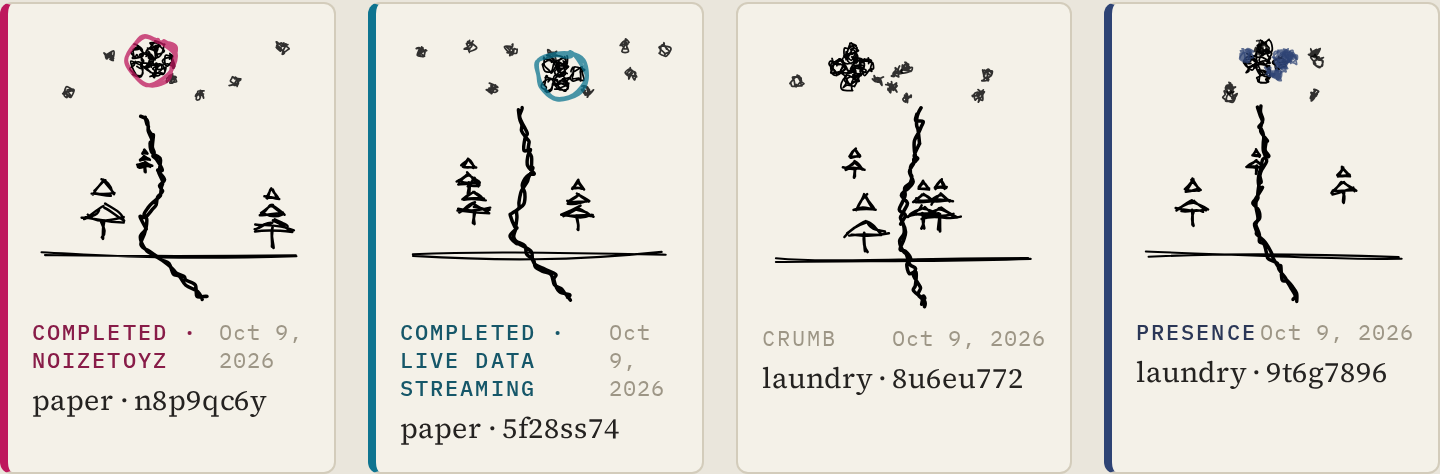
This is my own trail as it looks now. The pink and teal rings are the two station completions I have scanned, the navy dots are a presence tag, and the plain card is an ordinary crumb. The drawing on each card is generated from the object's id, so the same object always draws as itself.
That post is the first real leap, between two accounts of mine. One account had tapped a laundry tag in September. I gave the tag to the other account, which tapped it, answered Yes to "Received this from?", and the link is a signed record in my Aster repository.
Road to atmospheric evidence
Today a breadcrumb is a claim about yourself. Nothing checks that you did a station, so a worksheet QR is a self-claim, not evidence. The leap prompt only appears if the person who gave you the object tapped it first. This is where Breadcrumbs stands now. The road from here is evidence that comes from the atmosphere itself: a completion tap that points at the record you actually wrote at the station, the sensor reading, the synth note, the toon on the wall. The trail record can already carry an evidence link to another record, but the page does not write one yet. That is the next piece. Part two is about why I think it is worth building.